Art That Displays Elements of Line Artwork That Displays Elements of Line
1. Line
There are many different types of lines, all characterized past their length beingness greater than their width. Lines tin be static or dynamic depending on how the artist chooses to employ them. They help determine the motion, direction and energy in a work of art. We run into line all around united states of america in our daily lives; telephone wires, tree branches, jet contrails and winding roads are just a few examples. Expect at the photo beneath to see how line is part of natural and synthetic environments.

In this image of a lightning storm we can see many different lines. Certainly the jagged, meandering lines of the lightning itself dominate the image, followed by the straight lines of the skyline structures and the coast line. At that place are more subtle lines also, similar the lights along the buildings. Lines are even implied past the reflections in the water.
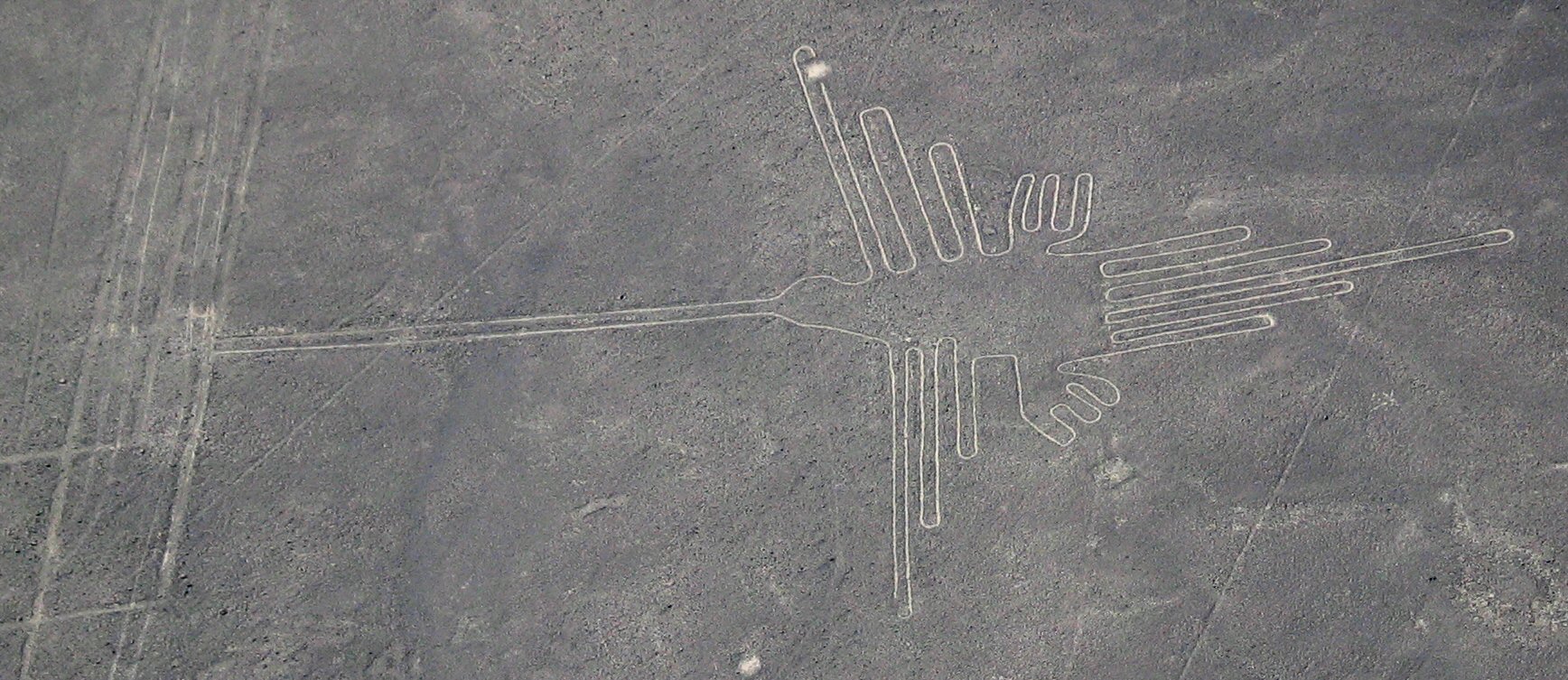
The Nazca lines in the arid coastal plains of Peru appointment to about 500 BCE were scratched into the rocky soil, depicting animals on an incredible calibration, so large that they are all-time viewed from the air. Allow'south look at how the dissimilar kinds of line are made.
Diego Velazquez'south Las Meninas from 1656, ostensibly a portrait of the Infanta Margarita, the daughter of King Philip 4 and Queen Mariana of Kingdom of spain, offers a sumptuous corporeality of artistic genius; its sheer size (almost ten feet square), painterly fashion of naturalism, lighting furnishings, and the enigmatic figures placed throughout the canvas–including the artist himself –is one of the bang-up paintings in western art history. Let'south examine information technology (below) to uncover how Velazquez uses basic elements and principles of art to achieve such a masterpiece.
Diego Velazquez, Las Meninas, 1656, oil on canvas, 125.2" x 108.7". Prado, Madrid. CC Past-SA
Actual lines are those that are physically nowadays. The border of the wooden stretcher bar at the left of Las Meninas is an actual line, as are the picture frames in the groundwork and the linear decorative elements on some of the figures' dresses. How many other actual lines tin can you find in the painting?
Unsaid lines are those created past visually connecting two or more areas together. The gaze to the Infanta Margarita—the blonde fundamental figure in the composition—from the meninas, or maids of honor, to the left and correct of her, are implied lines. They visually connect the figures. Past visually connecting the space between the heads of all the figures in the painting we have a sense of jagged implied line that keeps the lower role of the limerick in motion, balanced against the darker, more static upper areas of the painting. Unsaid lines can likewise be created when two areas of different colors or tones come together. Can you place more implied lines in the painting? Where? Unsaid lines are found in three-dimensional artworks, too. The sculpture of the Laocoon below, a figure from Greek and Roman mythology, is, forth with his sons, being strangled by ocean snakes sent by the goddess Athena as wrath against his warnings to the Trojans not to accept the Trojan equus caballus. The sculpture sets implied lines in motility as the figures writhe in agony against the snakes.
Laocoon Group, Roman copy of Greek original, Vatican Museum, Rome. Photo by Marie-Lan Nguyen. CC BY-SA
Directly or classic lines provide structure to a composition. They can be oriented to the horizontal, vertical, or diagonal axis of a surface. Directly lines are past nature visually stable, while still giving direction to a composition. InLas Meninas, yous can see them in the canvas supports on the left, the wall supports and doorways on the correct, and in the groundwork in matrices on the wall spaces between the framed pictures. Moreover, the small horizontal lines created in the stair edges in the background assist anchor the entire visual pattern of the painting. Vertical and horizontal straight lines provide the most stable compositions. Diagonal straight lines are usually more visually dynamic, unstable, and tension-filled.
Straight lines, xi July 2012, Creator: Oliver Harrison. CC By
Expressive lines are curved, adding an organic, more dynamic character to a work of art. Expressive lines are oft rounded and follow undetermined paths. In Las Meninas you tin can run into them in the aprons on the girls' dresses and in the dog's folded hind leg and coat pattern. Await again at the Laocoon to run across expressive lines in the figures' flailing limbs and the sinuous grade of the snakes. Indeed, the sculpture seems to be made upward of nothing but expressive lines, shapes and forms.
Organic lines, 11 July 2012, Creator: Oliver Harrison. CC BY
In that location are other kinds of line that encompass the characteristics of those above yet, taken together, help create additional creative elements and richer, more than varied compositions. Refer to the images and examples below to become familiar with these types of line.
Outline, or contour line is the simplest of these. They create a path around the edge of a shape. In fact, outlines often ascertain shapes.
Outline, eleven July 2012, Creator: Oliver Harrison. CC By
Hatch lines are repeated at short intervals in by and large 1 direction. They give shading and visual texture to the surface of an object.
Hatch, 11 July 2012, Creator: Oliver Harrison. CC BY
Crosshatch lines provide additional tone and texture. They tin can be oriented in whatever direction. Multiple layers of crosshatch lines tin can give rich and varied shading to objects past manipulating the pressure level of the drawing tool to create a big range of values.
Crosshatch, xi July 2012, Creator: Oliver Harrison. CC BY
Line quality is that sense of grapheme embedded in the style a line presents itself. Certain lines have qualities that distinguish them from others. Hard-edged, jagged lines have a staccato visual motility while organic, flowing lines create a more comfy feeling. Meandering lines can be either geometric or expressive, and you can see in the examples how their indeterminate paths animate a surface to unlike degrees.
Lines, 11 July 2012, Creator: Oliver Harrison. CC Past
Although line as a visual element generally plays a supporting office in visual art, there are wonderful examples in which line carries a strong cultural significance as the primary subject affair.
Calligraphic lines utilise quickness and gesture, more than akin to paint strokes, to imbue an artwork with a fluid, lyrical character. To see this unique line quality, look up the work of Chinese poet and artist Dong Qichang, dating from the Ming dynasty (1555-1637). A more than geometric example from the Koran, created in the Arabic calligraphic style, dates from the 9th century.
Both these examples show how artists employ line as both a form of writing and a visual art grade. American artist Mark Tobey (1890–1976) was influenced past Oriental calligraphy, adapting its form to the act of pure painting inside a modern abstract style described as white writing.
2. Shape
A shape is defined as an enclosed expanse in two dimensions. By definition shapes are always flat, but the combination of shapes, color, and other means can brand shapes appear three-dimensional, as forms. Shapes tin be created in many means, the simplest by enclosing an area with an outline. They can too be fabricated by surrounding an area with other shapes or the placement of dissimilar textures adjacent to each other—for case, the shape of an island surrounded by water. Considering they are more than complex than lines, shapes are normally more important in the arrangement of compositions. The examples beneath requite united states an idea of how shapes are fabricated.
Geometric Shapes, xi July 2012, Creator: Oliver Harrison. CC BY
Referring dorsum to Velazquez'due south Las Meninas, it is fundamentally an arrangement of shapes; organic and hard-edged, calorie-free, dark and mid-toned, that solidifies the composition within the larger shape of the canvas. Looking at it this fashion, we can view any work of art, whether two or three-dimensional, realistic, abstruse or non-objective, in terms of shapes lone.
Geometric Shapes vs. Organic Shapes
Shapes can be further categorized into geometric and organic. Examples of geometric shapes are the ones nosotros can recognize and proper noun: squares, triangles, circles, hexagons, etc. Organic shapes are those that are based on organic or living things or are more free form: the shape of a tree, face, monkey, cloud, etc.
3. Form
Course is sometimes used to describe a shape that has an implied third dimension. In other words, an artist may effort to make parts of a flat image announced 3-dimensional. Notice in the drawing below how the artist makes the different shapes announced three-dimensional through the use of shading. It'south a apartment image but appears iii-dimensional.
 This paradigm is free of copyright restrictions.
When an epitome is incredibly realistic in terms of its forms (every bit well equally color, infinite, etc.) such as this painting past Edwaert Collier, we phone call that trompe fifty'oeil, French for "fool the center."
 Edweart Collier, Trompe l'oeil with Writing Materials,
oil on canvas, c. 1702.
This image is in the public domain.
four. Infinite
Space is the empty area surrounding or between real or implied objects. Humans categorize space: there is outer infinite, that limitless void we enter across our sky; inner space, which resides in people's minds and imaginations, and personal space, the of import just intangible area that surrounds each private and which is violated if someone else gets too shut. Pictorial infinite is flat, and the digital realm resides in cyberspace. Art responds to all of these kinds of infinite.
Many artists are equally concerned with space in their works as they are with, say, color or course. There are many ways for the creative person to present ideas of space. Remember that many cultures traditionally use pictorial space as a window to view realistic subject field matter through, and through the subject affair they present ideas, narratives and symbolic content. The innovation of linear perspective, an implied geometric pictorial construct dating from fifteenth-century Europe, affords united states the accurate illusion of three-dimensional space on a flat surface, and appears to recede into the distance through the apply of a horizon line and vanishing point(due south) . You can run across how i-indicate linear perspective is ready upwardly in the examples below:
Ane-Bespeak Linear Perspective, xi July 2012, Creator: Oliver Harrison. CC BY
One-signal perspective occurs when the receding lines appear to converge at a single point on the horizon and used when the flat front of an object is facing the viewer. Note: Perspective can be used to show the relative size and recession into space of whatever object, but is most effective with hard-edged three-dimensional objects such as buildings.
A classic Renaissance artwork using ane point perspective is Leonardo da Vinci'due south The Last Supper from 1498. Da Vinci composes the work past locating the vanishing point directly behind the caput of Christ, thus drawing the viewer's attending to the center. His arms mirror the receding wall lines, and, if nosotros follow them as lines, would converge at the same vanishing betoken.

Leonardo da Vinci, The Concluding Supper, 1498. Fresco. Santa Maria della Grazie. Work is in the public domain.
Two-point perspective occurs when the vertical edge of a cube is facing the viewer, exposing ii sides that recede into the distance, one to each vanishing signal.
2-Point Perspective, 11 July 2012, Creator: Oliver Harrison. CC By
View Gustave Caillebotte's Paris Street, Rainy Atmospheric condition from 1877 to see how 2-bespeak perspective is used to give an authentic view to an urban scene. The artist's composition, withal, is more complex than only his use of perspective. The figures are deliberately placed to direct the viewer's eye from the front correct of the picture to the edifice'south forepart edge on the left, which, similar a ship's bow, acts as a cleaver to plunge both sides toward the horizon. In the midst of this visual recession a lamp mail stands firmly in the eye to arrest our gaze from going right out the back of the painting. Caillebotte includes the little metal arm at the top right of the post to direct us again along a horizontal path, at present keeping us from traveling off the top of the sail. As relatively spare as the left side of the work is, the artist crams the right side with hard-edged and organic shapes and forms in a circuitous play of positive and negative infinite.
The perspective system is a cultural convention well suited to a traditional western European idea of the "truth," that is, an accurate, clear rendition of observed reality. Even after the invention of linear perspective, many cultures traditionally use a flatter pictorial space, relying on overlapping, size differences, or vertical placementof components in a ii-dimensional piece of work of art. Examine the miniature painting of the Third Court of the Topkapi Palacefrom fourteenth-century Turkey to contrast its pictorial space with that of linear perspective. Information technology's composed from a number of different vantage points (equally opposed to vanishing points), all very flat to the picture aeroplane. While the overall image is seen from above, the figures and trees appear every bit cutouts, seeming to float in mid air. Notice the towers on the far left and right are sideways to the picture plane. The copse and people occupying the upper parts of the prototype are meant to exist perceived as further from the viewer as compared to those copse, buildings and people located near the bottom of the painting. This is an case of vertical placement.
As "wrong" as it looks, the painting does give a detailed clarification of the landscape and structures on the palace grounds.
Third Courtroom of the Topkapi Palace, from the Hunername, 1548. Ottoman miniature painting, Topkapi Museum, Istanbul. CC By-SA
After nearly five hundred years using linear perspective, western ideas nigh how space is depicted accurately in two dimensions went through a revolution at the first of the xxth century. A young Spanish artist, Pablo Picasso, moved to Paris, then western civilization's capital of art, and largely reinvented pictorial infinite with the invention of Cubism, ushered in dramatically by his painting Les Demoiselles d'Avignon in 1907. He was influenced in part by the chiseled forms, angular surfaces and disproportion of African sculpture (refer back to the Male person Figurefrom Republic of cameroon) and mask-like faces of early Iberian artworks. For more than information near this important painting, mind to the following question and answer.
In the early 20th century, Picasso, his friend Georges Braque and a handful of other artists struggled to develop a new space that relied on, ironically, the flatness of the picture plane to carry and animate traditional discipline affair including figures, still life and landscape. Cubist pictures, and eventually sculptures, became amalgams of dissimilar points of view, lite sources and planar constructs. It was as if they were presenting their subject area matter in many ways at once, all the while shifting foreground, middle ground and groundwork and then the viewer is non sure where one starts and the other ends. In an interview, the artist explained cubism this mode: "The problem is at present to pass, to go around the object, and give a plastic expression to the event. All of this is my struggle to break with the two-dimensional aspect*"(from Alexander Liberman, An Artist in His Studio, 1960, page 113). Public and disquisitional reaction to cubism was understandably negative, but the artists' experiments with spatial relationships reverberated with others and became – along with new ways of using colour – a driving force in the development of a mod art movement that based itself on the flatness of the picture show plane. Instead of a window to look into, the apartment surface becomes a footing on which to construct formal arrangements of shapes, colors and compositions. For another perspective on this idea, refer back to module i's give-and-take of 'abstraction'.
You can run across the radical changes cubism made in George Braque's landscape La Roche Guyonfrom 1909. The trees, houses, castle and surrounding rocks comprise almost a single complex class, stair-stepping upward the canvas to mimic the afar hill at the acme, all of it struggling upwardly and leaning to the right within a shallow pictorial space.
George Braque, Castle at La Roche Guyon, 1909. Oil on canvas. Stedelijk van Abbe Museum, Eindhoven, Netherlands. Licensed through GNU and Creative Commons
Every bit the cubist fashion developed, its forms became even flatter. Juan Gris's The Sunblindfrom 1914 splays the still life it represents across the canvas. Collage elements like newspaper reinforce pictorial flatness.
Juan Gris, The Sunblind, 1914. Gouache, collage, chalk, and charcoal on sheet. Tate Gallery, London. Epitome licensed under GNU Complimentary Documentation License
Information technology'southward not so difficult to understand the importance of this new idea of space when placed in the context of comparable advances in science surrounding the plough of the nineteenth century. The Wright Brothers took to the air with powered flight in 1903, the same twelvemonth Marie Curie won the first of two Nobel prizes for her pioneering piece of work in radiation. Sigmund Freud's new ideas on the inner spaces of the heed and its issue on behavior were published in 1902, and Albert Einstein'south calculations on relativity, the idea that space and time are intertwined, beginning appeared in 1905. Each of these discoveries added to homo understanding and realligned the mode we expect at ourselves and our world. Indeed, Picasso, speaking of his struggle to define cubism, said "Even Einstein did non know it either! The condition of discovery is exterior ourselves; simply the terrifying thing is that despite all this, we can only find what we know" (from Picasso on Art, A Selection of Views by Dore Ashton, (Souchere, 1960, page 15).
Three-dimensional space doesn't undergo this central transformation. It remains a visual and actual relationship between positive and negative spaces.
5. Value and Contrast
Value (or tone) is the relative lightness or darkness of a shape in relation to some other. The value calibration, bounded on one end by pure white and on the other past black, and in between a series of progressively darker shades of gray, gives an artist the tools to make these transformations. The value scale below shows the standard variations in tones. Values almost the lighter cease of the spectrum are termed high-keyed, those on the darker end are low-keyed.
Value Calibration, 11 July 2012, Creator: Oliver Harrison, CC Past
In 2 dimensions, the use of value gives a shape the illusion of class or mass and lends an unabridged limerick a sense of light and shadow. The ii examples below show the effect value has on irresolute a shape to a course.
| second Form, xi July 2012, Creator: Oliver Harrison, CC BY | 3D Course, eleven July 2012, Creator: Oliver Harrison, CC By |
This same technique brings to life what begins as a unproblematic line drawing of a boyfriend'south caput in Michelangelo'south Head of a Youth and a Right Paw from 1508. Shading is created with line (refer to our discussion of line earlier in this module) or tones created with a pencil. Artists vary the tones by the amount of resistance they use betwixt the pencil and the paper they're drawing on. A drawing pencil'due south leads vary in hardness, each one giving a different tone than another. Washes of ink or color create values determined by the amount of h2o the medium is dissolved into.
The apply of high contrast, placing lighter areas of value confronting much darker ones, creates a dramatic upshot, while low contrast gives more than subtle results. These differences in issue are evident in 'Guiditta and Oloferne' by the Italian painter Caravaggio, and Robert Adams' photograph Untitled, Denver from 1970-74. Caravaggio uses a high contrast palette to an already dramatic scene to increase the visual tension for the viewer, while Adams deliberately makes use of low contrast to underscore the drabness of the landscape surrounding the figure on the bicycle.
Caravaggio, Guiditta Decapitates Oloferne, 1598, oil on canvas. National Gallery of Italian Fine art, Rome. This work is in the public domain
6. Color
Color is the virtually complex creative element because of the combinations and variations inherent in its use. Humans respond to color combinations differently, and artists written report and use color in part to give desired direction to their work.
Colour is key to many forms of fine art. Its relevance, use and function in a given piece of work depend on the medium of that piece of work. While some concepts dealing with colour are broadly applicative across media, others are not.
The full spectrum of colors is contained in white light. Humans perceive colors from the light reflected off objects. A reddish object, for example, looks ruby considering information technology reflects the red part of the spectrum. It would be a different color nether a dissimilar light. Colour theory first appeared in the 17th century when English language mathematician and scientist Sir Isaac Newton discovered that white light could be divided into a spectrum by passing it through a prism.
The written report of color in fine art and design often starts with colour theory. Color theory splits up colors into three categories: chief, secondary, and tertiary.
The bones tool used is a color wheel, developed by Isaac Newton in 1666. A more circuitous model known equally the colour tree, created by Albert Munsell, shows the spectrum fabricated upward of sets of tints and shades on connected planes.
At that place are a number of approaches to organizing colors into meaningful relationships. Most systems differ in structure but.
Traditional Model
Traditional color theory is a qualitative attempt to organize colors and their relationships. It is based on Newton'due south colour bicycle, and continues to be the most common arrangement used by artists.
Blue Xanthous Red Color Bike. Released nether the GNU Free Documentation License
Traditional colour theory uses the same principles every bit subtractive color mixing (see below) just prefers dissimilar principal colors.
- The primary colors are red, blue, and yellow. You find them equidistant from each other on the color bicycle. These are the "elemental" colors; not produced by mixing whatever other colors, and all other colors are derived from some combination of these three.
- The secondary colors are orangish (mix of red and yellow), green (mix of blueish and yellowish), and violet (mix of blue and red).
- The tertiary colors are obtained past mixing i main color and one secondary colour. Depending on corporeality of color used, dissimilar hues can be obtained such as red-orange or yellow-green. Neutral colors (browns and grays) tin be mixed using the three main colors together.
- White and blackness lie exterior of these categories. They are used to lighten or darken a color. A lighter color (made by adding white to information technology) is called a tint , while a darker colour (made past adding black) is called a shade .
Color Mixing
Think virtually color as the issue of calorie-free reflecting off a surface. Understood in this way, color can be represented equally a ratio of amounts of master color mixed together. Color is produced when parts of the external light source's spectrum are absorbed by the material and non reflected back to the viewer'due south middle. For case, a painter brushes blue paint onto a canvas. The chemical limerick of the paint allows all of the colors in the spectrum to be captivated except blueish, which is reflected from the paint'due south surface. Common applications of subtractive color theory are used in the visual arts, color press and processing photographic positives and negatives.
- The master colors are blood-red, xanthous, and blue.
- The secondary colors are orange, dark-green and violet.
- The tertiary colors are created by mixing a primary with a secondary colour.
- Black is mixed using the three chief colors, while white represents the absence of all colors. Annotation: because of impurities in subtractive color, a truthful black is impossible to create through the mixture of primaries. Because of this the result is closer to brown. Similar to additive color theory, lightness and darkness of a color is determined past its intensity and density.
Subtractive Color Mixing. Released under the GNU Gratuitous Documentation License
Color Attributes
There are many attributes to color. Each 1 has an effect on how we perceive it.
- Hue refers to colour itself, but likewise to the variations of a color.
- Value (as discussed previously) refers to the relative lightness or darkness of i color next to another. The value of a color can brand a difference in how it is perceived. A color on a dark background volition appear lighter, while that aforementioned color on a light groundwork will appear darker.
- Saturation refers to the purity and intensity of a color. The primaries are the nearly intense and pure, but diminish every bit they are mixed to form other colors. The cosmos of tints and shades also diminish a colour's saturation. Two colors work strongest together when they share the aforementioned intensity.
Colour Interactions
Beyond creating a mixing bureaucracy, color theory besides provides tools for agreement how colors piece of work together.
Monochrome
The simplest color interaction is monochrome. This is the employ of variations of a single hue. The reward of using a monochromatic color scheme is that you go a high level of unity throughout the artwork because all the tones relate to one some other. See this in Mark Tansey'due south Derrida Queries de Man from 1990.
Coordinating Color
Analogous colors are similar to one another. As their name implies, analogous colors can exist institute adjacent to ane another on any 12-part color wheel:
Analogous Color, xi July 2012, Creator: Oliver Harrison. CC By
You can see the result of analogous colors in Paul Cezanne'south oil painting Auvers Panoromic View
Color Temperature
Colors are perceived to have temperatures associated with them. The colour wheel is divided into warm and cool colors. Warm colors range from yellow to red, while absurd colors range from yellow-green to violet. You tin can achieve complex results using simply a few colors when yous pair them in warm and cool sets.
Warm cool colour, 11 July 2012, Creator: Oliver Harrison. CC Past
Complementary Colors
Complementary colors are constitute directly reverse one some other on a color cycle. Hither are some examples:
- purple and yellow
- green and red
- orange and bluish
Complementary Color, 11 July 2012, Creator: Oliver Harrison. CC BY
Blue and orangish are complements. When placed near each other, complements create a visual tension. This color scheme is desirable when a dramatic result is needed using only two colors.
seven. Texture
At the most basic level, Three-dimensional works of art (sculpture, pottery, textiles, metalwork, etc.) and compages accept actual texture which is often determined by the textile that was used to create information technology: forest, stone, statuary, clay, etc. Ii-dimensional works of art like paintings, drawings, and prints may effort to evidence unsaid texture through the utilise of lines, colors, or other ways. When a painting has a lot of actual texture from the application of thick paint, we call that impasto.
The beginning image below is a sculpture, and like all three-dimensional objects information technology has actual texture.

The next ii images are details from the painting The Arnolfini Portrait past Jan van Eyck. Here, the artist has created implied texture. If yous were to touch on this painting you would not feel the fabric of the clothing and carpet, the wooden floor or the polish metal of the chandelier, but our eyes "see" the texture.


0 Response to "Art That Displays Elements of Line Artwork That Displays Elements of Line"
Post a Comment